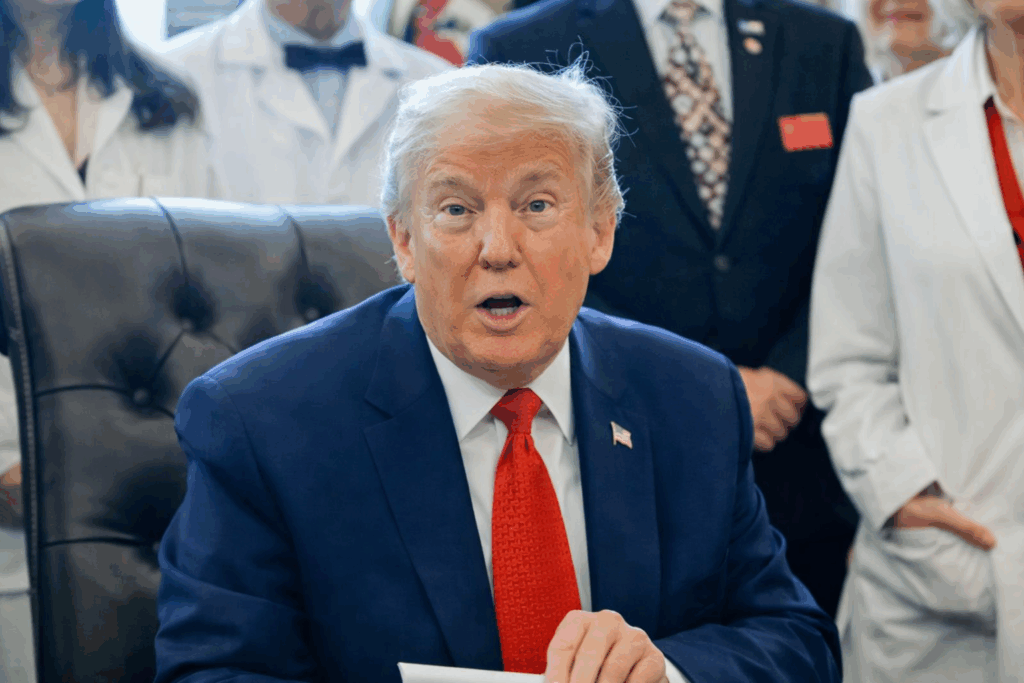
President Donald Trump on Dec. 18 ordered the federal government to reclassify marijuana as a less dangerous substance, marking the most significant shift in U.S. cannabis policy since the Controlled Substances Act more than five decades ago.
The order instructs federal agencies to remove marijuana from Schedule I — the most restrictive category under federal law — and reclassify it as a Schedule III substance. Schedule I drugs are defined by the Drug Enforcement Administration as having no accepted medical use and a high potential for abuse and include heroin, LSD, and ecstasy. Schedule III substances, by contrast, are recognized as having legitimate medical uses and a moderate to low risk of physical or psychological dependence.
“Today, I’m pleased to announce that I will be signing an executive order to reschedule marijuana from a Schedule I to a Schedule III controlled substance with legitimate medical uses,” Trump said while announcing the move. He emphasized that the change stops well short of nationwide legalization, adding that the order “is not the legalization — does it legalize marijuana in any way, shape or form, and no way sanctions its use as a recreational drug.”
To implement this directive, Trump’s order instructs Attorney General Pam Bondi to “take all necessary steps to complete the rulemaking process” required to formally reschedule marijuana. The order also signals the administration’s intent to work with Congress on redefining hemp-derived cannabinoid products, including cannabidiol, or CBD, to expand access while maintaining regulatory oversight.
Legal scholars have weighed in on the executive action, noting that it sends a strong signal about the administration’s priorities, even as the final outcome will depend on the completion of federal rulemaking. “This gives (rescheduling) a big push forward and sends a pretty clear signal about the likely outcome,” said David Pozen, a law professor at Columbia University and author of The Constitution of the War on Drugs. Still, Pozen cautioned that the move will not end longstanding political debates over marijuana policy, calling it “a big deal for the rescheduling debate” but “by no means” a resolution of broader conflicts.
Although marijuana will remain illegal under federal law without congressional action, the reclassification could immediately impact the cannabis industry, particularly by allowing standard business tax deductions for companies handling Schedule III drugs. Currently, firms dealing with Schedule I substances are barred from many deductions under federal law. This tax change could provide immediate financial relief and reshape industry operations.
As Pozen explains, “The main effect of rescheduling will be a tax cut for marijuana firms,” clarifying that, “This won’t authorize medical marijuana at the federal level.”
Markets responded quickly to the announcement. Shares of major cannabis companies rose in premarket trading on Dec. 18, reflecting investor optimism that rescheduling could reduce regulatory burdens and attract new capital. Industry analysts say the move could also accelerate medical research, encourage standardized drug development, and improve access to financing, even though interstate sales would remain prohibited unless the Food and Drug Administration approves marijuana-based medications.
Beyond financial impacts, the administration is also considering additional steps related to access for seniors. According to reports, Trump is weighing a Medicare pilot program that would allow limited access to CBD products, a move that could further legitimize cannabinoid-based treatments and draw interest from large institutional investors.
The federal shift comes amid widespread state-level legalization and changing public attitudes. When the Controlled Substances Act was enacted in 1970, marijuana was grouped with the most dangerous drugs. Since then, two dozen states, three U.S. territories, and the District of Columbia have legalized or regulated recreational marijuana, according to Reuters. Nearly all states — 45 — allow marijuana for medical or recreational use in some form.
In tandem with legislative developments, public opinion has shifted just as dramatically. Nearly two-thirds of Americans support legalization, according to an October Gallup poll, up from just 36% two decades ago.
Despite that support, marijuana policy remains politically contentious. In Ohio, Republican Gov. Mike DeWine has backed legislation restricting where marijuana can be grown, prompting lawsuits from cannabis businesses over limits on THC-infused products.
In Florida, a 2024 ballot initiative to legalize marijuana for adults 21 and older failed to meet the state’s 60% approval threshold despite receiving nearly 56% of the vote, following vocal opposition from Gov. Ron DeSantis.
Against this mixed backdrop, Trump’s approach to marijuana contrasts with his aggressive enforcement posture toward other drugs. During his second term, the Pentagon has carried out strikes against suspected drug-smuggling vessels linked to fentanyl and cocaine trafficking. Yet Trump has also voiced support for reducing penalties for marijuana possession, particularly for small amounts intended for personal use.
He reinforced this distinction during the 2024 campaign while endorsing the failed Florida measure, saying, “I believe it is time to end needless arrests and incarcerations of adults for small amounts of marijuana for personal use.”
The executive order builds on earlier federal efforts. Former President Joe Biden ordered a review of marijuana’s classification in 2022, and the Department of Health and Human Services proposed rescheduling in 2024, though that effort stalled earlier this year.
Trump acknowledged the issue’s divisiveness while campaigning, noting, “Some people like it, some people hate it. Some people hate the whole concept of marijuana.”
While the order does not resolve the nation’s long-running marijuana debate, it represents the most consequential federal acknowledgment to date that cannabis may have legitimate medical value — a shift that could reshape research, regulation, and the industry’s future.