
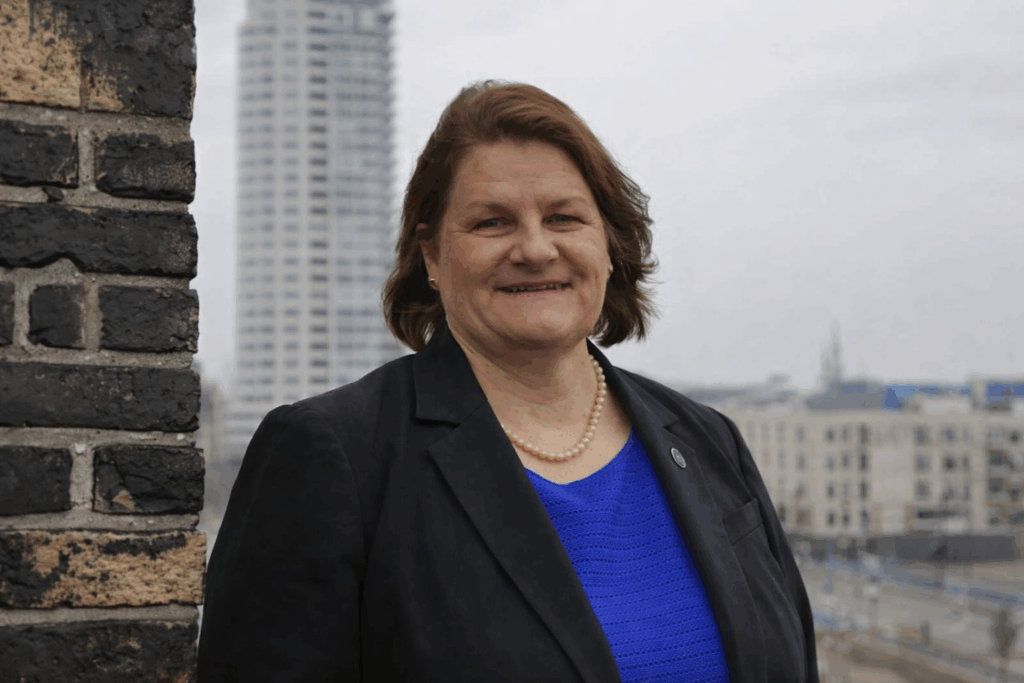
A federal jury’s conviction of Milwaukee County Circuit Judge Hannah Dugan on a felony obstruction charge has placed the Wisconsin jurist at the center of a national legal and political debate. This marks the first time a state judge has gone to trial for allegedly interfering with federal immigration enforcement.
After six hours of deliberation, a jury of seven men and five women found Dugan guilty of obstructing federal agents but acquitted her on a lesser misdemeanor. Dugan, 66, a nine-year judge, showed no reaction as the verdict was read. No sentencing date is set.
The case has been closely watched nationwide. Protests were held outside the courthouse. Supporters and critics reacted sharply. The trial unfolded during President Donald Trump’s intensified immigration crackdown in his second term. This policy expanded immigration agents’ authority to make arrests in and around courthouses. The change drew resistance from judges and legal advocates.
Interim U.S. Attorney Brad Schimel denied political motivation, stressing the case focused only on Dugan’s actions during a single court session.
“We weren’t trying to make an example out of anyone,” Schimel said after the verdict. “This was necessary to hold Judge Dugan accountable because of the actions she took. There’s not a political aspect to it.”
Schimel also urged the public to view the case in context, framing it as a matter of accountability rather than ideology.
“Some view this as part of a larger political battle,” he said. “But this case concerns a single day in a public courthouse.”
Defense attorney Steve Biskupic noted the split verdict, saying the defense will ask U.S. District Judge Lynn Adelman to set aside the conviction, arguing the charges shared the same elements.
“The case is far from over,” Biskupic said, adding that the defense will aggressively pursue post-trial motions.
The jury foreperson declined to give his name but acknowledged the case’s emotional toll.
“I am not feeling too good,” he said, adding that jurors followed Judge Adelman’s instructions. Other jurors declined to comment.
An ordinary court day quickly turned extraordinary.
The case stems from April 18, when Dugan was presiding over misdemeanor court. Tensions were high after federal immigration officers arrested two suspected undocumented individuals.
Federal agents arrived to arrest Eduardo Flores-Ruiz, a 31-year-old Mexican national charged with misdemeanor battery. Flores-Ruiz had previously been deported and illegally re-entered the United States in 2013.
Court testimony showed that Dugan learned of the planned arrest from her clerk. She went into the main corridor with another judge, questioned the agents about their authority, and directed them to the chief judge’s office, where courthouse leadership was drafting guidance on handling immigration arrests.
After returning to the courtroom, prosecutors said, Dugan moved Flores-Ruiz’s case up on the docket. She directed him and his attorney through a non-public door typically used by judges and staff. Witnesses testified that the pair emerged into a public hallway. Agents followed them. Flores-Ruiz was arrested outside the courthouse after a brief foot chase and was later deported.
A week later, FBI agents arrested Dugan at the courthouse, leading her away in handcuffs — a moment that galvanized both critics and supporters.
A trial focused on intent
Prosecutors emphasized that the facts of the case were largely undisputed. They focused instead on Dugan’s intent. They highlighted five actions they described as unusual for a busy misdemeanor courtroom. They presented courtroom audio and surveillance video to argue that Dugan deliberately created an opportunity for Flores-Ruiz to flee.
One recording captured Dugan telling her court reporter she would personally escort Flores-Ruiz and “take the heat,” a statement prosecutors argued showed awareness of wrongdoing.
Judge Kristela Cervera, a colleague of Dugan’s, testified that judges should not assist defendants in evading arrest.
“Judges should not be helping defendants evade arrest,” Cervera told the jury.
Under cross-examination, Cervera acknowledged texting her sister, an attorney, to warn that immigration agents were in the building. The defense raised this point to cast doubt on her credibility. Prosecutors minimized the significance of the message.
Defense argues confusion, overreach.
Dugan did not testify. Her defense called fellow judges, a public defender, and former Milwaukee Mayor Tom Barrett, a longtime friend, to portray her as a conscientious public servant navigating unclear policies.
Defense attorneys argued that immigration enforcement rules at the courthouse were in flux and that Dugan believed she was following protocol rather than obstructing agents. They also unsuccessfully sought dismissal of the case, claiming judicial immunity—an argument Judge Adelman rejected while allowing it to be preserved for appeal.
The verdict is widely viewed as legally monumental. Experts call it a bellwether for the evolving clash between state courts and federal immigration enforcement. Before Trump’s first term, courthouse arrests were largely discouraged. His administration expanded its use in 2018 and has accelerated it again in his second term.
As Dugan prepares for post-trial motions and potential sentencing, the case is expected to reverberate far beyond Wisconsin. It will shape how judges nationwide respond when federal immigration policy intersects with the day-to-day administration of justice.