
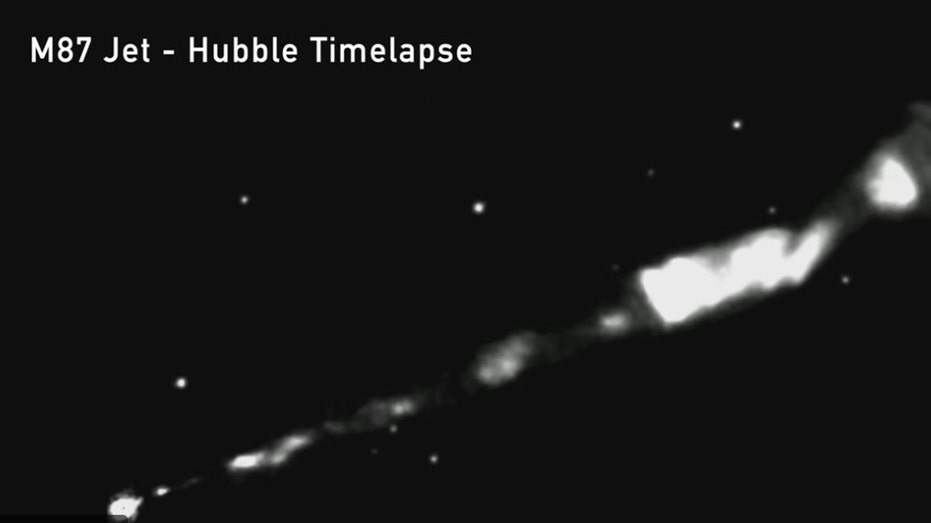
WASHINGTON, D.C. — Researchers have successfully pinpointed the origin of a colossal 3,000-light-year-long jet streaming from the supermassive black hole M87, the first black hole ever imaged, thanks to significant advancements in global telescope coordination. This breakthrough, detailed in a recent publication in Astronomy & Astrophysics, provides compelling observational evidence elucidating how such cosmic jets are launched at velocities approaching the speed of light.
Located approximately 55 million light years from Earth in the Messier 87 galaxy, M87 is a behemoth, estimated to be 6.5 billion times the mass of our sun. The initial image of M87’s event horizon, captured in 2017 and publicly released in 2019 by the Event Horizon Telescope (EHT) collaboration, marked a historic milestone in astrophysics. Building on that foundation, scientists have now leveraged enhanced coverage from the EHT’s expanded network to trace the jet’s source with unprecedented precision.
Dr. Padi Boyd of NASA explained in a video accompanying the study that M87 is not only supermassive but also an active black hole, a rarity among such cosmic giants. “Just a few percent are active at any given time,” she noted. “Understanding whether these black holes turn their jets on and off, and the role of magnetic fields in launching these jets, is a key question in astrophysics.” The enhanced EHT observations have provided direct evidence linking M87’s powerful magnetic fields to the acceleration of particles that form the jet.
This jet, which stretches an astonishing 3,000 light years into space, is composed of charged particles propelled at nearly the speed of light, illuminating the surrounding interstellar medium and influencing galaxy evolution. The ability to trace the jet back to its source near the black hole’s event horizon offers critical insights into the mechanisms driving these energetic outflows.
The study’s findings also contribute to a broader understanding of black hole activity cycles and the complex interplay between gravity, magnetism, and high-energy particle physics. As the EHT continues to enhance its capabilities, future observations are expected to shed further light on the dynamic processes occurring in the vicinity of black holes.
For those interested in the technical details and ongoing research, the NASA Chandra X-ray Observatory provides extensive resources on black hole jets and their impact on galactic environments. Additionally, the National Science Foundation supports many of the ground-based observatories contributing to this global effort.
This landmark achievement underscores the power of international collaboration and cutting-edge technology in unraveling the mysteries of the universe’s most enigmatic objects. As scientists continue to decode the secrets of M87 and other black holes, our understanding of cosmic phenomena grows ever deeper, promising new discoveries on the horizon.