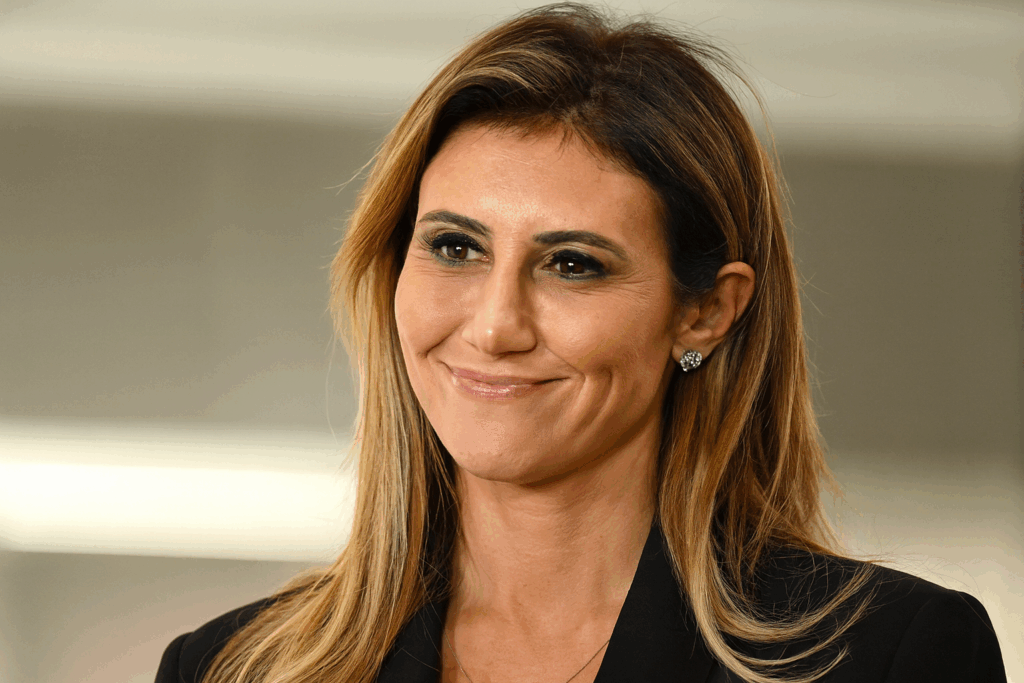
A federal appeals court on Monday upheld a ruling that bars Alina Habba — President Donald Trump’s former personal attorney — from continuing to serve as acting U.S. attorney for the District of New Jersey, marking a significant legal setback for the administration and escalating an already widened debate over its prosecutorial appointment practices.
In a 32-page opinion, the Third U.S. Circuit Court of Appeals concluded that Habba’s appointment violated the Federal Vacancies Reform Act, affirming a lower court judge’s finding that the administration employed strategies that exceeded its statutory authority. Writing for the panel, Judge Michael Fisher said, “It is apparent that the current administration has been frustrated by some of the legal and political barriers to getting its appointees in place,” noting that the steps used to reinstall Habba after her interim term expired “run afoul of the law.”
The case originated from legal challenges filed by three New Jersey defendants who argued that Habba’s authority was invalid because her appointment circumvented Senate confirmation. Although the trial judge declined to dismiss their indictments, he agreed Habba should be disqualified — a conclusion the appeals court endorsed after reviewing the government’s actions surrounding her elevation.
Attorneys who contested Habba’s appointment praised the ruling. In a joint statement, lawyers Abbe Lowell, Gerry Krovatin, and Norm Eisen said the decision confirms that “Habba is unlawfully and invalidly serving as the chief federal law enforcement officer in New Jersey, marking the first time an appellate court has ruled that President Trump cannot usurp longstanding statutory and constitutional processes to insert whomever he wants in these positions.” Their challenge mirrors broader concerns raised across multiple federal districts about appointments made without Senate consent.
The Justice Department declined to comment on the ruling, while the U.S. attorney’s office in New Jersey did not immediately respond to inquiries. The White House referred questions back to the DOJ. Habba, who previously represented Trump in both civil and criminal matters, had defended her position by arguing she was fighting for nominees nationwide who “have been denied a chance for a Senate hearing,” a claim she reiterated in a statement to X shortly after her October oral arguments.
The dispute traces back to March, when Trump named Habba interim U.S. attorney — a position limited to 120 days under federal law. After Trump nominated her for the permanent role in June, the Senate did not act on the nomination. As the clock ran down, federal judges in New Jersey designated her deputy as the new interim U.S. attorney. In response, Attorney General Pam Bondi dismissed the deputy, appointed Habba as “Special Attorney to the Attorney General” with full prosecutorial authority, and then reappointed her to the deputy role, which immediately elevated her once more to acting U.S. attorney.
The appeals panel rejected that framework entirely, ruling that Bondi “can’t delegate all the power of the office” simply by assigning the special-attorney designation. The judges warned that the administration’s theory “would create a means for the Department of Justice to circumvent the FVRA’s exclusivity provision, effectively permitting anyone to fill the U.S. Attorney role indefinitely. This should raise a red flag.”
Monday’s decision arrives on the heels of another major legal rebuke to Trump-aligned prosecutors. Last week, a federal judge dismissed indictments against former FBI Director James Comey and New York Attorney General Letitia James after finding that Acting U.S. Attorney Lindsey Halligan was unlawfully appointed. U.S. District Judge Cameron Currie wrote that Halligan, also a former Trump attorney, “had no lawful authority to present the indictment.” The administration has already vowed to appeal that ruling.
The latest decision adds to a growing list of judicial findings questioning the administration’s use of accelerated or improvised appointment methods. It also deepens the uncertainty surrounding ongoing prosecutions initiated by officials whose authority courts have deemed invalid.